Tarrinzeau Fairground
The Man Who LaughsTarrinzeau Fairground is a Southwark entertainment ground built on former bowling-green land, known in the novel as Tarrinzeau Field. Its shifting ownership, itinerant performers, and densely assembled crowds make it both a practical home for the Green Box troupe and a stage on which popular acclaim is sharply separated from aristocratic recognition.
Setting and Name
The ground lay near the Thames, behind Lambeth House and nearly opposite St. James’s Palace, in a strip of open land between a pottery and a glass-blower’s workshop. The space had once been a bowling-green; its name, Tarrinzeau Field, recalled its connection to the Barons Hastings, who also bore the titles Barons Tarrinzeau and Mauchline. The place thus carried traces of an older landed history even after its use and ownership changed.
Ownership and Fairground Life
Tarrinzeau Field passed from the Lords Hastings to the Lords Tadcaster, who treated it as a commercial speculation. It later became waste ground and parochial property. In practice, it was anything but empty: the field operated as a permanent fairground, crowded with jugglers, athletes, mountebanks, and performers on platforms. Its continuous bustle made it a place where spectators could come to see extraordinary acts throughout the year.
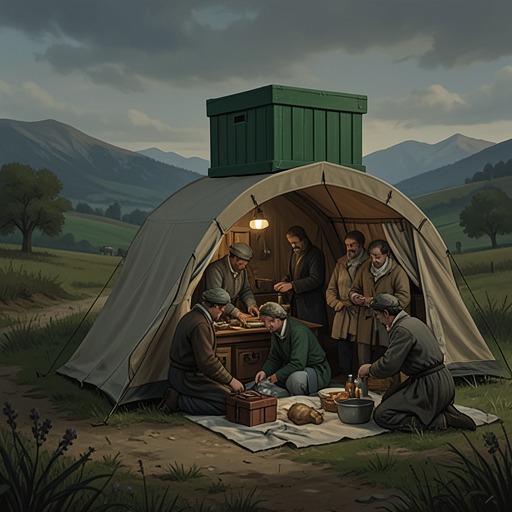
The surrounding inns served this transient trade. Most were little more than stalls, open during the day and locked up when their keepers left in the evening. Only one was a house and a settled dwelling within the fairground. The performers’ caravans, by contrast, could disappear at any moment, reflecting the unsettled life of the travelling entertainers who made the field their workplace.
The Green Box at Southwark
When the Green Box troupe reached London, Ursus established it at Southwark and chose the fairground because its chief attraction was that every day was fair-day, even in winter. The troupe began performing, and crowds immediately gathered. Ursus had prepared a place for genteel visitors, furnishing a box with the inn’s best chairs and setting a grand yellow Utrecht velvet armchair in its centre for a possible alderman’s wife. The reserved compartment for the nobility nevertheless remained empty.
The rest of the ground responded in the opposite way. Southwark flocked to see Gwynplaine, and the troupe’s success exceeded what its performers had known before. The established mountebanks were unsettled by his drawing power: the narrative compares him to a hawk let loose among smaller birds, consuming the audience that had supported their acts. The fairground’s mixed entertainments included music and other performances, but Gwynplaine became its overwhelming attraction.
Performance and Social Contrast
Ursus had written Chaos Vanquished expressly for Gwynplaine and regarded it as his best work. In its dark opening, Gwynplaine, Ursus, and a wolf appeared as man, bear, and beast; the two animals overwhelmed the man, and the audience watched him struggle until a sudden light revealed Gwynplaine’s disfigured face. The reversal transformed the crowd’s alarm into laughter. The response spread beyond those who could see the stage: passers-by who heard the laughter joined in, and applause and stamping followed. The show became a popular success, accessible for a penny, while fashionable spectators avoided it.
Dea’s presence complicated the audience’s view of the performance. Blind, she experienced the crowd only as a murmur and felt isolated until she found Gwynplaine by touching his head. Her gesture expressed trust and love; spectators, seeing the pair from the outside, interpreted their roles differently, regarding Gwynplaine as the loved one and Dea as his rescuer. The fairground therefore presented two simultaneous readings of the same bodies: public spectacle and intimate recognition.
The empty aristocratic compartment at Tarrinzeau Fairground anticipates a wider divide in Gwynplaine’s story. The people who gather at the penny show acclaim him, but that success does not secure acceptance among the peers. Later, in the House of Lords, candlelight again makes his face the centre of attention; when emotion brings on his uncontrollable laughter, the assembly turns his speech into a joke. Across these contrasting spaces, the fairground’s applause marks real popular response, not a welcome from the social order whose attention Gwynplaine later seeks.